Sustainability
Chairperson–President Dialogue
Chairperson–President Dialogue
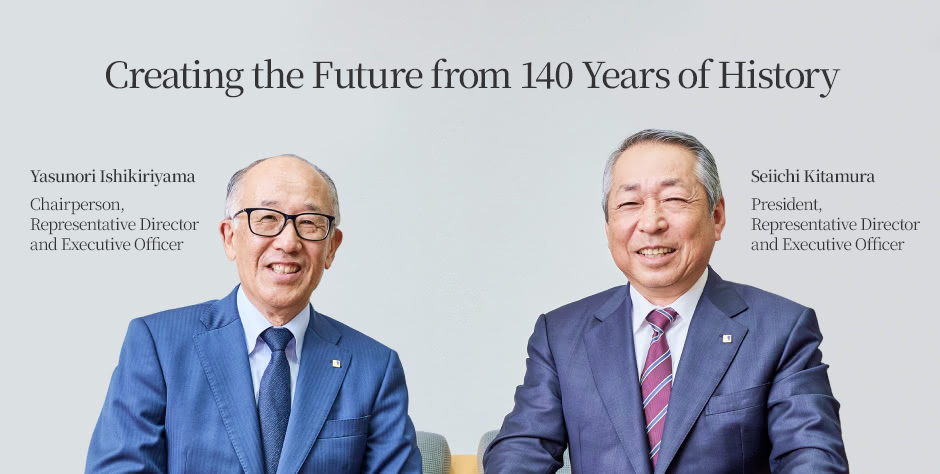
This fiscal year marks both the significant milestone of our 140th anniversary and the important first year of Phase 2 of the Medium- to Long-Term Business Plan SHIFT2030. As we drive SHIFT2030 forward in this turbulent times under the new management structure led by Chairperson Ishikiriyama and President Kitamura, the two leaders exchanged views on the strategies to guide our Group toward further growth, the aspirations embodied in SHIFT, and the strengths built over Nitta’s 140 years as well as the challenges ahead.
SHIFT2030 launched amidst turbulent times
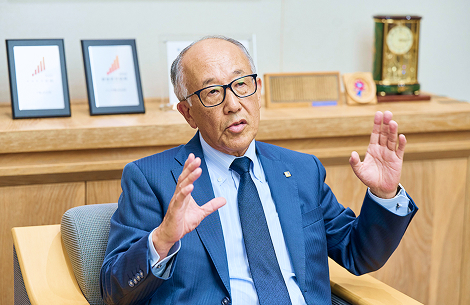
Ishikiriyama) At the major milestone of our 140th anniversary, we now move into Phase 2 of SHIFT2030 under President Kitamura’s leadership. I became president in December 2019, and soon began the process of formulating the Medium- to Long-Term Business Plan SHIFT2030 in the midst of the COVID-19 pandemic. That adversity gave us the opportunity to re-examine our present position and our future.
SHIFT2030 is our once-in-a-decade medium- to long-term business plan, setting forth the direction in which our Company should move. The concept behind “SHIFT” stems from our belief that in a world undergoing major transformation, we too must change and evolve. Even now, it continues to serve as a powerful guiding message for us. In Phase 2, we will build on the achievements to date and accelerate further growth and transformation.
Kitamura) SHIFT2030 began shortly after Chairperson Ishikiriyama assumed the presidency, at a time when our former Chairperson, Motonobu Nitta, had passed away and the initial stages of the COVID-19 pandemic were unfolding. At that time, I was head of the belt and rubber products department and fully occupied with our on-site response. Our belt and rubber products business was trusted as an essential supplier even overseas, so it was our mission to continue production without interruption. We did everything possible—using air and sea transport, among other means—to fulfill our supply responsibilities. Employee awareness of the necessity of our work was very high, and thanks to rigorous infection prevention measures implemented at the production sites, we were able to continue operations safely.
This experience brought about a change in mindset among our employees, fostering flexible thinking and new initiatives. As a result, our performance did not suffer a significant decline and it became an opportunity to reaffirm the underlying strength of our organization.
Ishikiriyama) The frontline teams, including the belt and rubber products department, responded with resilience and ingenuity under extremely difficult conditions. Amid the global impact of the pandemic, I was prepared for a decline in results. I knew there was no point in being overly nervous because I knew our frontline employees would give their utmost effort. Even with then-General Manager Kitamura, we did not hold any special meetings just because of the pandemic. Our strength lies in diversification and globalization, with risks mitigated across dispersed businesses and markets. It was my belief that if each department responded to its circumstances and worked with full effort to achieve the best results locally, good outcomes would naturally follow.
Kitamura) If something irregular occurred, we reported it as needed, but otherwise the frontline was trusted to manage. However, they were struggling to manage the constant inflow of orders. Disruptions in logistics caused delays in product deliveries, leading to customer anxiety and, in turn, excessive ordering. Although using air and sea transport incurred substantial costs, we prioritized fulfilling our supply responsibilities above all else. The departments made sure to share information closely regarding order handling and infection prevention measures, striving to meet customer expectations.
As department head, I saw that our employees have a strong sense of responsibility and are very earnest. When faced with an issue, they would quickly gather and exchange opinions without regard to hierarchy. Everyone looked in the same direction and advanced together. Especially during the pandemic, I found the sight of our employees working this way very reassuring.
Ishikiriyama) That is exactly what I find most admirable about our Company. Our steady commitment to meeting customer expectations and our cooperative approach among employees demonstrate how the founding philosophy of invention, harmony, and innovation has permeated the entire Company. As I understand it, this philosophy was codified by later generations of employees. It is a truth they themselves grasped, so it is understood and internalized in their own words. Building good relationships together and working cooperatively is at the heart of harmony, and that naturally equips us to foster good relationships with all stakeholders.
Challenges in new technologies and businesses create Nitta’s future
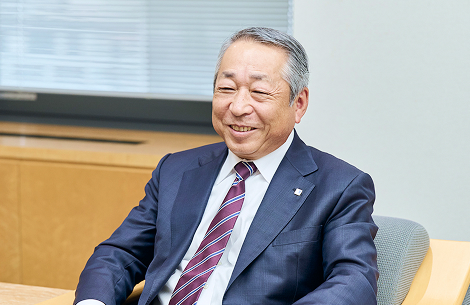
Kitamura) Our employees are serious and sincere. They also embody the Mission, Values, and Principles set forth in our Group Philosophy.
Ishikiriyama) Being earnest and diligent is important. But here in the throes of turbulent times, flexibility in responding to change, fresh ideas, and bold concepts will become increasingly critical as expressed in SHIFT. For our Company to continue growing, it is essential that we strike a balance between what should be preserved and what should be actively transformed.
Kitamura) Every person has multifaceted potential, and dialogue and environment are key to drawing that out. Exposure to others’ perspectives is valuable, as it leads to new awareness and fresh ideas. To drive transformation forward, I want to create a workplace with active exchanges inside and outside the Company, where diverse perspectives intersect.
Our 140-year history is one of consistently taking on new technologies and businesses in response to social change. At the core of this has always been “people”—the ability of each individual to fully realize their potential is the key to sustainable growth.
Ishikiriyama) Exactly. New technologies and businesses are what shape the Company’s future. In SHIFT2030, strengthening existing businesses and exploring new ones are the twin pillars. Investing the capital and human resources cultivated through existing businesses into new fields represents the most suitable growth model for our Company. M&A is one such measure. For example, Nitta Chemical Industrial Products, which became a subsidiary in December 2017 through share acquisition, has advanced structural reforms through selection and concentration, achieving sales of 13 billion yen. In the air conditioning products business, consolidation of sales companies and strengthening of the Taiwanese market have contributed to establishing a profitable structure. Development of the Indian market and decontamination market also promise future growth. The hose and tube products business is also beginning to show results with strategies focusing on construction machinery and semiconductors. Each existing business produced results in Phase 1 of SHIFT2030, but we must not let these achievements be temporary. In Phase 2, we would like you, as President, to continue taking the helm as one of the key priorities and to lead us to significant achievements.
Kitamura) In addition to achieving numerical targets in Phase 1, we also advanced the review of product portfolios in each business department. Building on this foundation in Phase 2, we will take on further growth.
Ishikiriyama) New businesses are important not only for sales, but also for expanding the Company’s potential and raising expectations for growth. Last fiscal year, we launched a new business producing and selling maple syrup from wild-growing maples, utilizing Hokkaido’s forest resources. This initiative, proposed by the New Business Exploration Team, has also brought about a shift in mindset that with the right plan, we can take on anything. Since this was in the food sector, not part of our core businesses, there was internal debate. There were suggestions that we could simply launch the maple syrup business at our existing sites such as the Hokkaido Enterprising Development Office or the Nitta Ranch. However, to encourage flexible thinking and the proposal of new initiatives, we decided to launch it separately as a venture company, Wakutto Nitta. Wakutto Nitta is a venture that symbolizes a corporate culture where anyone can take on challenges with creative ideas, which will also serve as a strength in recruitment. We are placing our hopes on Wakutto Nitta not for its sales, but for its role in stimulating existing businesses with free and creative ideas.
Trust-based relationships with stakeholders drive growth
Kitamura) By securing solid profits from our existing businesses, we can boldly take on challenges in new products and business fields. To me, this is our strength and a true source of corporate value.
Ishikiriyama) A company’s value lies not only in its sales and profits but also in its ability to continue growing into the future and the expectations that come with it. Although our business performance remains steady, it is crucial to maintain an attitude of continuous improvement and growth rather than satisfaction with the status quo. At present, our PBR (price-to-book ratio) is 0.7 times and our PER (price-earnings ratio) is 8 times, both below where they should be. This indicates a lack of expectations for the future. It is essential not only to demonstrate growth and corporate value through business performance but also to actively show society bold and swift actions that raise those expectations.
Kitamura) For rapid growth, it is important not only to create new businesses internally but also to actively adopt new technologies and ideas from outside. In the past, many technologies that did not exist in Japan could be found overseas and incorporating them led to business expansion in the domestic market. However, we now live in an age when such technologies are not easily found. That is why we must carefully seek out companies that have technologies that can strengthen or complement our businesses. Collaboration and partnerships with external entities to create new value and expand future possibilities will be key to our growth going forward.
Ishikiriyama) I look forward to President Kitamura exercising his leadership to move us toward the major goals of SHIFT2030 and the achievement of dynamic growth and new value creation. My predecessor as president once said, “The landscape changes when net sales exceed 100 billion yen,” and I want to witness that transformation together. In Phase 2, I hope you will cultivate new businesses and growth fields on a large scale.For example, new materials like Namd™ and products related to decontamination are showing promising signs of long-term growth, even if they take time to mature. In Phase 2, it will be vital to nurture these opportunities and develop them into future pillars of our business. Although there are movements around the world toward national-first policies and economic prioritization, the fundamental principles of environmental responsibility and the importance of global economic activity remain unchanged. Rather than being swayed by short-term trends, focusing on the essence of what truly matters is the key to achieving sustainable growth. Our environmental management and global management approaches, which have been passed down through generations, will continue to serve as the cornerstones of our management foundation.
Kitamura) In my opinion, long-lasting companies share three characteristics: flexibility in responding to changes in the times, a clear management philosophy, and deep trust by customers. For example, we plan to utilize the overseas distributor network built by the belt products business for other business areas. This is only possible thanks to the deep trust we have established with our distributors. This trust was built through education grounded in a clear corporate philosophy and the development of talented individuals. Flexibility, philosophy, and trust—these three elements are interlinked and form the core foundation supporting our Company’s growth. To continue growing, cooperation among employees, trust with our business partners, and connections with all those who support our Company will become our greatest driving force. By building harmonious relationships with all stakeholders and drawing strength from these bonds, we will boldly take on the challenges of SHIFT2030 and continue our steady march toward the future.
Ishikiriyama) Together, we will aim for the ideal future of Nitta and a new horizon.